History in the Making
Like us on Facebook
  • Home
  • Show Status
    • Wellington County Museum & Archives
    • Dufferin County Museum & Archives
    • Hopson Grace
  • Introduction
  • The Stories
    • The Stories Part 1 >
      • Queen's Wharf
      • The Cottage at St. Helena
      • The Underwater Wood
      • Cedar Split Rail Fences
      • The Creemore Log Cabin
      • A Brigantine's Bumper
      • The Barn in Vermilion, Alberta
      • Langdon Hall
      • Hudson's Bay Company Post at Michicopoten
      • The Wood from Queen's Park
    • The Stories Part 2 >
      • The Spar of a 1946 Aeronca Champ Aircraft
      • The Northfield House
      • The Muir Table Leaves
      • The Mystery Piece
      • Beacon Marine
      • The Mansfield General Store
      • Mulmur Barns >
        • The Brown's Barn
        • The Horner's Barn
      • Lakefield College School
      • The Mad River Pottery
      • Midland Secondary School
    • The Stories Part 3 >
      • The House of Industry & Refuge Barn
      • The House of Industry & Refuge Barn 2
      • The Wooden Land Roller
      • The Horse from Windfields Farm
      • George Armstrong's Fence Line
      • The A-frame
      • The Palmerston Library
  • Prices
    • How to Purchase
  • Acknowledgements
  • Contact
  • Blog

The Wooden Land Roller

In this short video (on the right) Susan Dunlop, the curator of the Wellington County Museum & Archives, gives us the story of this wooden land roller.

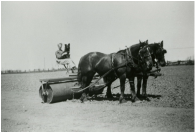
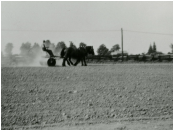
It was very hard to find images of wooden land rollers and in the end I had to settle for metal ones. However, the way they are used is the same. 
Picture
Picture
Logs were more handy and far cheaper than metal when these devices first came into use.  But metal was superior in the end and prices came down to make them more affordable.

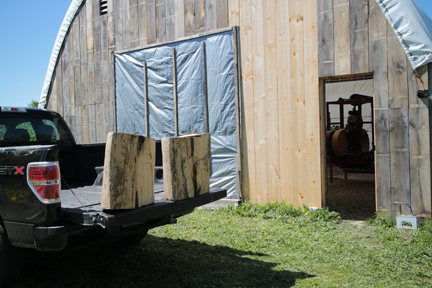
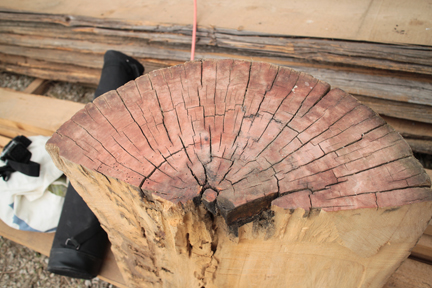
I took a piece of the wood to have it identified.  My own feeling is that it might be elm.  It is very hard to tell as the wood has deteriorated and is quite soft.

Cutting up the roller disturbed a rather large nest of ants.  Even after getting the pieces back to the studio, there were still some that were late on leaving.
Picture
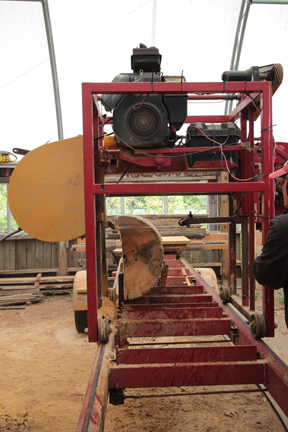
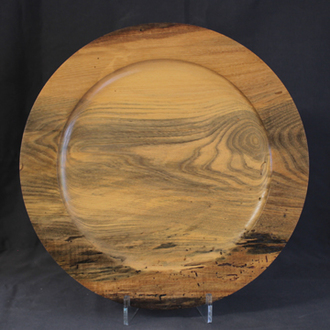
I took the wood to the sawmill and aftersome thought and discussion we decided to cut it into slabs suitable for making platters.  In this case, a platter is the best way of 'showing off' the wood.  Due to the wood being so uniform in grain one needs a larger visible area to get a feel for the subtleties in it.
Picture
Picture
Each cut brought a different perspective on the roller.

This video covers the highlights of making the platter from the land roller.
Picture
"For Those Who Work the Land"

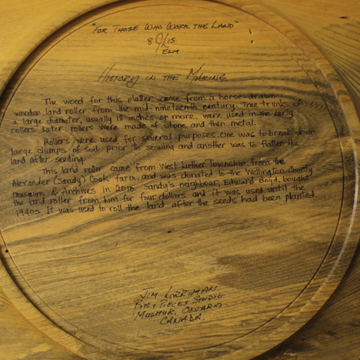
The story of the wooden land roller has been written on the back of the platter.

This piece is for sale.  If you are interested, please go to the price page for more information.
Picture

Back to the Top, Home or On to the Next Story

Picture